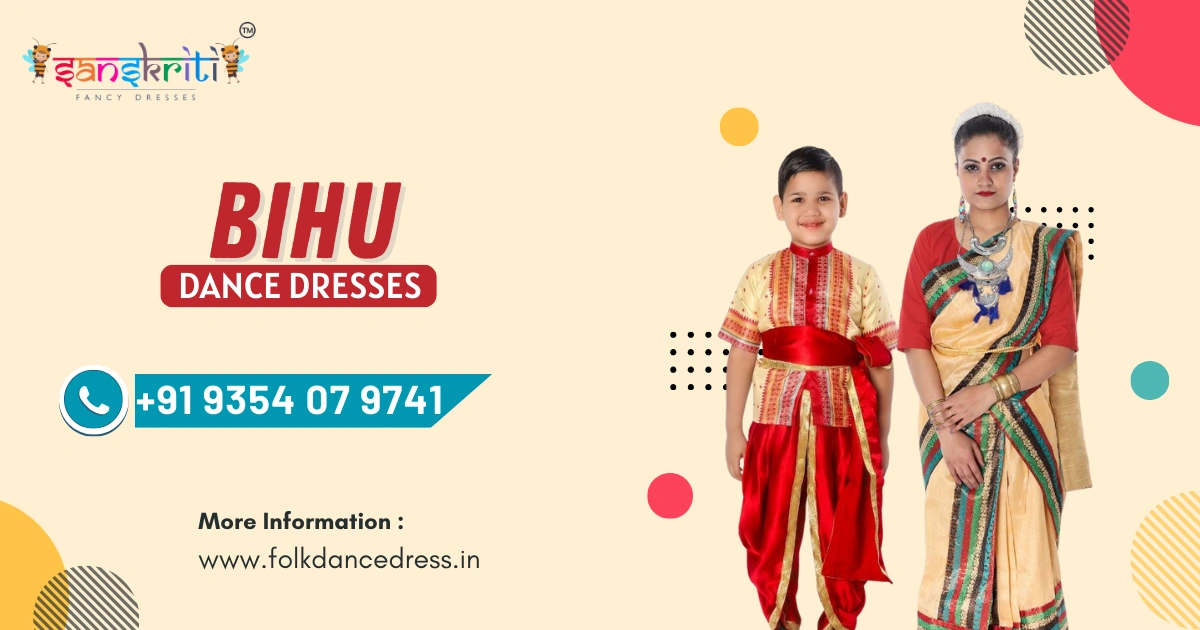
Bihu Dance Dress is bright, traditional and full of the warm spirit of Assam. It brings life to the famous Bihu dance, which is performed during the Assamese New Year. The costume helps the dancers move freely while also showing the beauty of Assamese culture.
Women usually wear the mekhela chador, which is elegant and colourful. Men wear a dhoti with a gamosa, which gives a fresh and traditional look. Add a bit of simple jewelry, tidy hair, and light makeup, and you’ve got the look.
You see the Bihu Dance Dress everywhere on festival stages, at school programs, in cultural parades. It doesn’t just stand out, it radiates joy and carries the spirit and history of Assam with it.
What is Bihu Dance?
Bihu Dance comes straight from Assam, and honestly, it’s hard to miss its wild energy. It’s all about fast moves, bright smiles, and music that pulls people in. When the Bihu festival rolls around New Year and harvest time, everyone joins in. Men and women dance together, moving quick, clapping, swaying, just letting loose in big groups while the dhol, pepa, and flute keep the rhythm going.
Bihu isn’t just a dance; it’s a burst of happiness and a celebration of nature and community. It brings people together and shows off Assam’s rich culture in the most joyful, down-to-earth way.
Culture and history behind Bihu Costume
Bihu costumes mean a lot to people in Assam. It is closely connected to the life, traditions and celebrations of the Assamese people. Bihu itself is a harvest festival, so everything about it is bursting with the energy of a fresh start, good crops, and the hope that comes with a new season. The way people dress for the dance really captures that feeling.
The mekhela chador worn by women has been part of Assamese clothing for many years. It is usually handwoven by local weavers. The designs and borders show the traditional art of Assam. Many outfits are made using threads of red, white and golden tones, which are important colours in Assamese culture.
Men wear a dhoti and gamosa. These aren’t just festival clothes; they’ve got history. The gamosa, especially, stands for respect and pride. You’ll see it at festivals, in prayers, and just in daily life.
Bihu dress is simple, but it say a lot about the connection between people, their land, and old traditions. Even now, dancers wear them with pride, holding on to something special and making sure it doesn’t fade away.
Main parts of the Bihu Dance Dress
Bihu dance dress is bright, traditional and easy to move in. It lets dancers stay light on their feet, all while showing off the spirit of Assamese culture. Here’s what you’ll see in a typical Bihu dance costume:
- Mekhela: Women wear this as the lower half of the dress, it’s basically a stunning, long skirt wrapped at the waist, almost always featuring rich borders and classic patterns.
- Chador: It goes on top of the mekhela. Dancers drape it across the torso, and its red and gold details give the whole look a certain elegance.
- Blouse: A simple blouse is worn under the chador. It is in matching colours like red, yellow or cream.
- Dhoti: It is made from soft and comfortable material that provides a no restriction feel when dancing the fast-paced and lively Bihu steps.
- Gamosa: It is an essential part of the Bihu costume worn by men, with its white background and red border. Men typically wear it around their neck or tie it on their heads.
- Jewellery: For women, traditional Assamese jewellery consisting of earrings, necklaces, and bangles, are worn in combination with their Bihu attire to give an overall soft glow.
- Footwear: Simple flat sandals or dancer’s shoes provide a sense of comfort and balance during dancing.
Mekhela Chador details for women
The Bihu dance requires women to wear mekhela chador, which is very comfortable and looks beautiful while they are dancing with quick movements.
- Mekhela: The mekhela is the bottom part of a woman’s costume. It wraps around the waist like a long skirt and is secured in place so a woman can move freely while performing the dance. It has decorative borders and is decorated with traditional Assamese motifs.
- Chador: The chador is a long piece of material that covers the top portion of the body, and it is positioned over a blouse and tucked in at one side. The chador typically features colourful intricate woven patterns (often in red and gold).
- Materials: Cotton, muga silk, eri silk, and pat silk are common materials used to create the mekhela chador. These types of materials have soft, lightweight characteristics and are ideal for dancing.
- Colour: Most mekhela chadors are available in cream, white, red, yellow, or gold colourations. In particular, the red edging and designs on Mekhela chadors are quite popular among Bihu dancers.
- Patterns: The patterns on mekhela chadors typically consist of woven flowers, geometric shapes, or traditional Assamese designs. This adds an additional element of elegance to the garments without being too heavy.
The mekhela chador is a simple yet elegant garment. The flow of the garment enhances the appearance of fluidity during the performance, thus displaying Assam’s rich heritage of art.
Dhoti and Gamosa costume for men
For the Bihu dance, men wear an outfit that is comfortable and reflects their culture. It is also very light and easy to move in.
For Men: The main garment worn by men as part of their Bihu dance attire is a dhoti. A dhoti consists of a piece of material that is long enough to wrap around the lower half of your body (the waist and Legs) providing a lot of freedom for fast and active steps during the Bihu dance, as well as an opportunity to express their manhood.
The majority of dhotis in Assam are usually white or cream in colour, however, some men will wear bright and colourful dhotis.
Men also tend to wear a simple and plain kurta or ‘top’ over their dhoti. Kurta is often very similar in colour to the Dhoti and gives the Male Dancer a clean, neat, and traditional appearance.
A very significant part of the male dancer’s costume is a gamosa. The Gamosa is a white piece of cloth with red borders and woven designs. The gamosa is typically worn around the neck, on the head (tied) and used during the performance. The gamosa is a representation of high respect and pride within the Assamese culture.
Most dancers wear simple, flat sandals or dance barefoot for extra grip. The dhoti-a and gamosa ensemble is a simple, traditional but culturally significant attire for men that creates a clean and timeless Assamese external appearance for the Bihu dancers.
How to choose the right Bihu dress
The selection of the Bihu dress is critical to the dancer’s performance on stage in terms of being comfortable while looking presentable. Several straightforward methods to assist you during your selection are listed below.
- Fabric – the fabric must be soft against the dancer’s skin and light enough to allow the dancer to perform the dance steps smoothly. Suggested fabrics for your selection include cotton, muga silk, eri silk or Pat silk.
- Color – the best colors for Bihu attire are cream, white, bright red, bright yellow, and gold. The proposed colors should represent the festive atmosphere of the Bihu Dance.
- Fit – the mekhela should fit securely on the dancer’s body without being tight. The chador needs to be securely attached to the dancer’s back so that it will not slip off during the Bihu Dance. The dhoti should allow enough room for a boy to perform.
- Design – a Bihu dress that has light patterns along the hem or border is ideal. Avoid heavy and ornate decoration if this dress will be worn by children or worn at school functions.
- Ease of management – the dancer should be able to perform without difficulty walking, turning, or bending. Always check the fit of the dress before the event.
- Jewellery – use as little jewellery as possible. Earrings should be small, the necklace should be modestly sized, and there may be 2 or 3 bangles. Overly ornate jewellery will impede the dancer’s ability to perform effectively.
A high-quality Bihu dress should allow the dancer to perform comfortably while representing tradition and cultural significance while allowing the dancer to express himself/herself comfortably and confidently.
Frequently Ask Questions
Q. What is Bihu dance dress?
A. Bihu Dance Dress is traditional attire worn by performers of the Bihu Dance in Assam, and it is made up of a Mekhela Chador for women and for men there is Dhoti, Kurta and Gamosa.
Q. What are the colours of Bihu Costumes?
A. The basic colours used to make Bihu Costumes include Cream, White, Red, Yellow and Gold.
Q. What are the best materials to make Bihu Dresses?
A. The most commonly used fabrics for Bihu dresses include Cotton, Muga Silk, Eri Silk, Pat Silk and Cotton Blended Fabrics.
Q. What type of jewelry do Bihu performers wear?
A. Few earrings, light necklaces and simple bangles.
Q. Should i buy or rent a Bihu dress?
A. If you plan to wear it often, you should buy it. If you plan to wear it for one time only, you should rent it.
Q. Can i make my own Bihu dress?
A. You can create a Bihu dress by making a simple mekhela-style skirt, a simple blouse and a dupatta.
